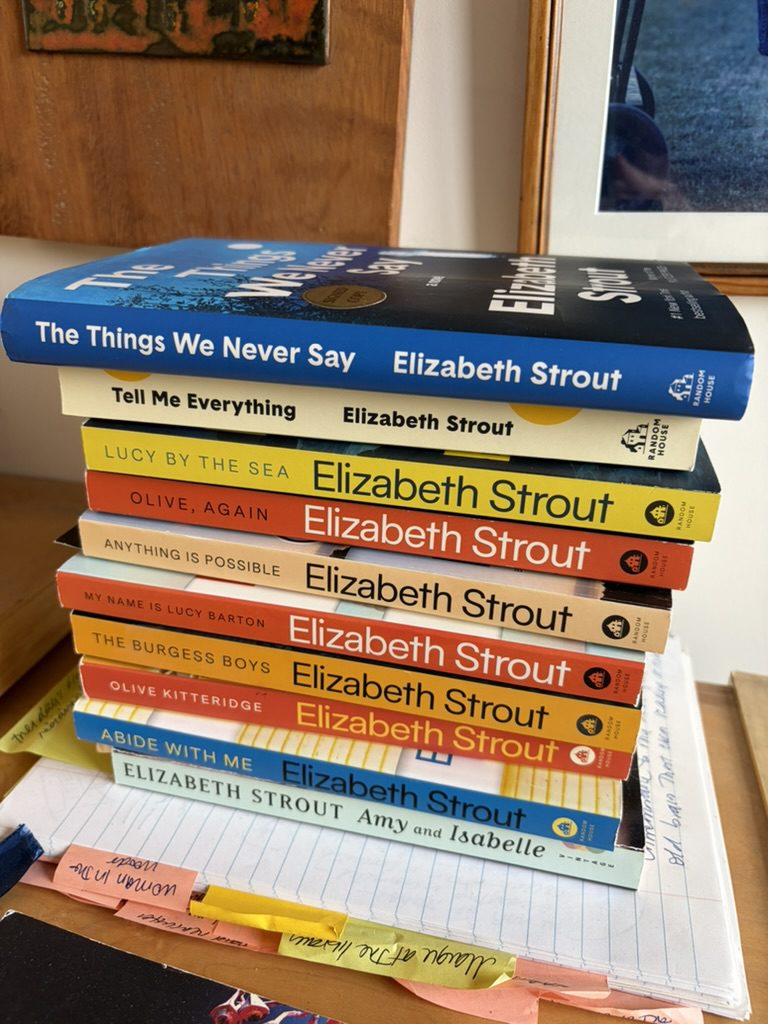


Over the weekend I finished my chronological read of Elizabeth Strout’s entire catalogue.
I do a deep dive like that every time I fall in love with a writer. When I fall in love with a writer, it’s because they’re telling a great story that almost completely shuts off my editor brain, but still allows me to see the craft and care they take in putting that story together.
I find those writers deeply deeply instructive.
I took so much away from my Strout reading!
How she uses weather to signal mood.
How she uses secondary characters to illuminate primary characters.
How she handles interiority through memory.
How she iterates on her big questions, how she examines every side of each theme.
How she presses her characters to sit in discomfort and to grow.
How much sympathy she grants them, which engenders real sympathy in the reader too.
OMG and how she makes you weep.
Reading her is a masterclass in how it’s done. She’s finally on the Booker shortlist, for a reason!
My unpopular opinion is that doing deep reads like this are just as good, if not better, than spending your time and money on an MFA.
I know what I’m talking about, because once upon a time I was a first year MFA student at Columbia.
I had some great teachers — Binnie Kirshenbaum and Sigrid Nunez, yes that Sigrid Nunez, among them. I met Philip Roth there.
For real: I sat in a small seminar around a table with Philip Roth.
I was serious about writing fiction and I was so excited to be surrounded by other people who wanted to write fiction … until I realized that the majority of my classmates wanted to write, but they didn’t read widely.
They didn’t really seem to read at all.
They had no interest in talking about new books, older books, classics. Our conversations were all about their work, never about what they found inspiring or instructive or simply thrilling in the millions of books that had come before.
I left that program a year in and moved to LA for a lot of reasons, but what pushed me out of Columbia was my feeling that I was depending on critique and support from a group of other writers who didn’t feel a part of a larger community of artists, who weren’t engaged in the ether of the art form.
That felt really empty to me.
I wanted peers who had grappled with the language and the stories of a multitude of writers, who could offer me not just their gut checks but their understanding of how what we were doing was related to — or breaking from — what had come before.
Those of us who want to write great work are best served by reading as widely as possible.
We are doing the work, with the giant stacks of to-be-read (TBR) books by our bed or our favorite chairs.
We are doing the work, as carry books in our bags, as we read while we eat, as we listen to audiobooks in the car or on the treadmill.
Reading other writers can teach us everything we need to know about story, about structure, about character and language and theme.
We are not just inspired by other writers — we are instructed by them.
We stand on the giant stacks of their works we call our TBRs.
This post recently appeared in one of my Unruly Writer newsletters, along with updates about my own writing, and listings of events and opportunities of interest to writers. You can get all of that sent directly to your inbox by subscribing to the Unruly Writer today.


Comments +